

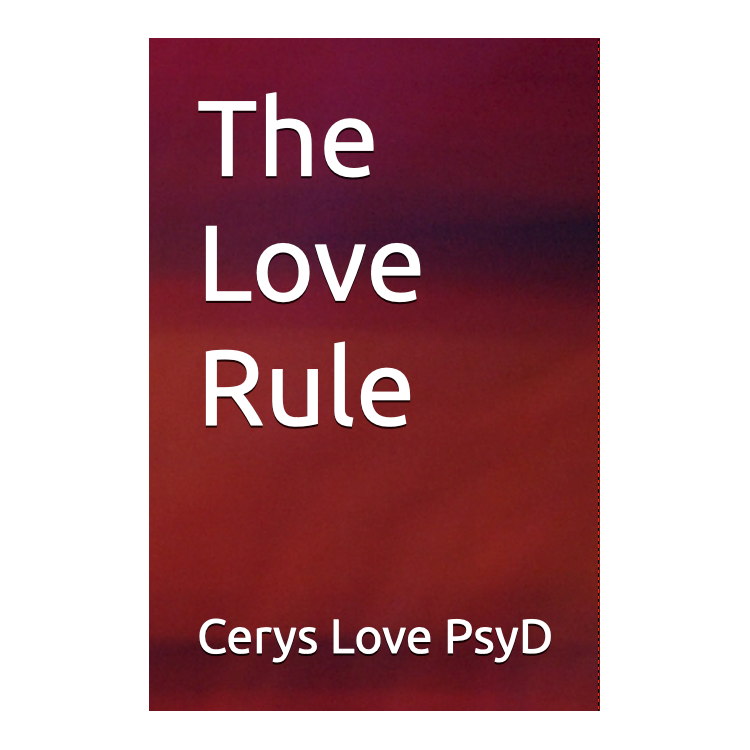
Editor's Notes Standing upon The Love Rule as a philosophical theoretical foundation, Mirror Psychology builds a clinical and social psychological theory, utilizing the latest neuroscience and bio-psycho-social-spiritual research. This research illustrates that loving something bigger than ourselves, loving ourselves, and loving our neighbors as we love ourselves in that order truly is all humanity needs to flourish. The concept is over 2000 years old - and yet is as revolutionary and relevant now as it was then - regardless of what you believe or don't believe about its author. As a pragmatic minimalist pulling the latest research thread in search of truth about optimal relationships with self and humanity, this doctor of clinical psychology is surprised to find that scientific thread circling back to this concept. It is not new. It is not sexy. What works is the point - and as a philosophical theoretical foundation for clinical as well as social psychology theory, and then as an applied concept for psychotherapy blended with experiential therapy, this works with elegant simplicity.
Copyright © 2022 Mirari Press. All rights reserved. Mirari Press.™ The Love Rule.™ Mirror Psychology.™ Mirror Psychotherapy.™ Mirror Experiential Therapy.™ Mirror Experiential Outreach.™ Élevé Sur La Vie.™ Mirror Social Psychology.™ Written and read as Cerys Love PsyD™ by Sherese Chrétien PsyD, CPPC, CPSP for Eliyora Entertainment, LLC, a division of Paradunai LLC. Ever Entertainment.® All copyrights, trademarks & images property of Paradunai LLC. All personas and concepts created by Sherese Chrétien.
ISBN: 9798418883513
More from Ever Entertainment®




Similar
The only person you are destined to become is the person you decide to be. ~Ralph Waldo Emerson
_________________________
SELFLESS ANONYMOUS
TIP JAR
If you enjoy
Ever Entertainment®
leave an anonymous tip
if you’re able
to help support more!
_________________________